Selling a property in Quebec in 2026 is not the same experience it was in 2020 or 2021. The market that saw bidding wars, waived conditions, and properties closing above asking price within days has given way to something more measured — a market where buyers are more deliberate, financing conditions are more carefully evaluated, and the sellers who succeed are those who approach the process with preparation rather than assumption.
That does not mean it is a difficult market to sell in. Demand for quality residential properties across Quebec remains solid, inventory in most segments is not excessive, and motivated, well-prepared sellers are still achieving strong results. But the definition of well-prepared has evolved, and sellers who do not adjust their approach to the current environment risk longer days on market, conditional deals that fall apart, and final sale prices that fall short of what was achievable with better strategy.
This guide is for Quebec property owners who are considering a sale in 2026 and want a clear, honest picture of what the process looks like — from the first conversation with a broker to the moment the deed is signed at the notary.
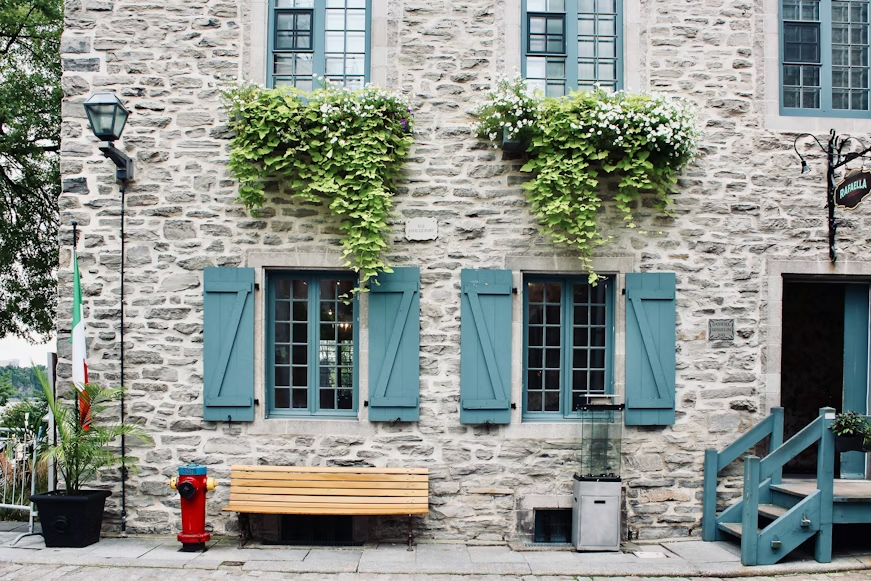
![[IMAGE 1: Hero image — Stunning Quebec City skyline featuring historic architecture and modern buildings along the St. Lawrence River, or aerial view of Montreal's diverse neighborhoods] Canadian real estate markets receive constant attention from investors worldwide, but Quebec often remains underappreciated compared to Toronto and Vancouver. This relative obscurity creates opportunity. While other markets grab headlines with dramatic price swings, Quebec delivers consistent performance that rewards patient, informed investors. Frédéric Murray recognized Quebec's potential when founding Groupe Murray nearly twenty years ago. While others chased hotter markets, he built Immeubles Murray by focusing on fundamentals that drive sustainable returns. Today, that portfolio stands as testament to Quebec's enduring investment appeal. Quebec's Economic Foundations Strong real estate markets require strong economic foundations, and Quebec delivers on multiple fronts. The province boasts a diversified economy spanning aerospace, technology, healthcare, education, financial services, and natural resources. This diversity provides resilience—downturns in any single sector don't devastate the broader economy. Montreal has emerged as a leading technology hub, attracting major investments from global companies and nurturing a vibrant startup ecosystem. Quebec City anchors government employment while developing its own technology and tourism sectors. Regional centers provide stability through healthcare, education, and resource industries. Employment diversity translates to rental demand diversity. Immeubles Murray properties attract tenants across industries, reducing exposure to any single employer or sector. Frédéric Murray prioritized this diversification when building the Groupe Murray portfolio, recognizing that broad-based demand creates stable, sustainable returns. [IMAGE 2: Economic diversity visual — Montreal tech district with modern office buildings, Quebec City's business district, or collage showing various industries: aerospace, healthcare, technology, education] Affordability Advantage Quebec offers remarkable affordability compared to other major Canadian markets. Montreal housing costs significantly less than Toronto or Vancouver, yet the city provides comparable urban amenities, cultural offerings, and economic opportunities. This value proposition attracts residents from across Canada and internationally. Affordability benefits investors in multiple ways. Lower acquisition costs mean smaller capital requirements to enter the market. More accessible pricing allows broader tenant pools, reducing vacancy risk. The gap between Quebec prices and other markets creates potential for continued appreciation as more people discover this value. For tenants, Quebec's affordability translates to sustainable housing costs. Residents can afford their apartments without excessive financial strain, leading to reliable rent payments and longer tenancies. This stability benefits property owners through consistent cash flow and reduced turnover costs. Groupe Murray's investment thesis has always incorporated Quebec's affordability advantage. Frédéric Murray understood that sustainable returns require sustainable tenant economics. Immeubles Murray rents remain accessible to working families while generating appropriate returns for investors. Demographic Tailwinds Quebec's demographics support continued housing demand. Immigration adds population steadily, with Quebec attracting newcomers seeking French-speaking environments, educational opportunities, and affordable living costs. International students attending Quebec's renowned universities often remain after graduation, adding to housing demand. Internal migration patterns also favor Quebec. Residents of more expensive provinces increasingly consider Quebec for its lower living costs and high quality of life. Remote work expansion accelerates this trend, allowing people to earn incomes from anywhere while enjoying Quebec's affordability. Household formation trends support rental demand specifically. Young adults delay homeownership longer than previous generations, extending their rental years. Older adults increasingly downsize into rental apartments, preferring flexibility and reduced maintenance responsibilities. These demographic shifts sustain rental demand across age groups. Frédéric Murray tracks demographic trends closely when planning Groupe Murray strategy. Immeubles Murray acquisitions target locations and property types aligned with demographic demand patterns, ensuring properties attract tenants reliably for decades to come. [IMAGE 3: Demographic appeal — diverse group of young professionals in urban Quebec setting, students near university campus, or multigenerational community enjoying neighborhood amenities] Regulatory Environment Quebec's rental regulations create a stable, predictable operating environment. While some investors view tenant protections skeptically, experienced operators recognize that balanced regulations benefit everyone. Clear rules reduce disputes, and tenant stability reduces turnover costs. The Régie du logement provides dispute resolution mechanisms that avoid expensive litigation. Standardized lease forms ensure consistent documentation. Rent increase guidelines, while limiting dramatic hikes, allow reasonable annual adjustments that maintain property economics. Professional operators who understand and respect Quebec's regulatory framework thrive within it. Problems arise primarily for those who ignore rules or attempt shortcuts. Compliance-focused management, like that practiced throughout Immeubles Murray, operates successfully within Quebec's system. Groupe Murray maintains strict regulatory compliance across all operations. Frédéric Murray established this commitment early, recognizing that sustainable business requires respecting the framework within which you operate. This approach builds trust with tenants, regulators, and partners alike. Infrastructure Investment Government infrastructure investment signals confidence in Quebec's future and directly enhances property values. Major transit projects improve accessibility to previously underserved areas. Road improvements reduce commute times. Public space investments enhance neighborhood desirability. Montreal's ongoing transit expansion creates opportunity for informed investors. Properties near new stations appreciate as accessibility improves. Neighborhoods previously considered distant become convenient, attracting new residents and commanding higher rents. Quebec City continues developing its infrastructure to support population growth. Municipal investments in roads, utilities, and public spaces accommodate expansion while maintaining quality of life. These improvements support property values throughout the region. Frédéric Murray monitors infrastructure planning closely when evaluating acquisition opportunities. Immeubles Murray includes properties positioned to benefit from announced and anticipated infrastructure investments. This forward-looking approach has driven significant value creation within the Groupe Murray portfolio. [IMAGE 4: Infrastructure and growth — modern Quebec transit system, urban development project under construction, or revitalized public space with people enjoying the amenities] Market Stability Quebec's real estate market historically demonstrates lower volatility than other Canadian markets. While Toronto and Vancouver experience dramatic cycles of appreciation and correction, Quebec moves more steadily. This stability suits investors seeking predictable returns rather than speculative gains. Lower volatility reflects Quebec's economic diversity, reasonable affordability, and balanced regulation. Markets with extreme price appreciation often experience painful corrections. Quebec's moderate, sustainable growth avoids these cycles, protecting investors from dramatic value swings. For income-focused investors, stability matters more than appreciation potential. Predictable cash flows support retirement income, portfolio planning, and reinvestment strategies. Quebec delivers this predictability consistently. Groupe Murray's investment approach prioritizes stable returns over speculative potential. Frédéric Murray built Immeubles Murray targeting sustainable performance rather than maximum short-term appreciation. This philosophy has protected the portfolio through economic cycles while delivering consistent results. Quality of Life Considerations Investment decisions involve more than spreadsheet analysis. Quebec offers exceptional quality of life that enhances its investment appeal. World-class cultural offerings, excellent restaurants, four-season recreation, and vibrant neighborhoods create environments where people want to live. Properties in desirable locations attract and retain quality tenants. Residents who enjoy their neighborhoods stay longer, maintain their apartments better, and create stable communities. Quality of life considerations translate directly into property performance. Quebec's healthcare system, educational institutions, and social services provide residents with security that enhances community stability. These factors may not appear in financial projections but influence long-term property performance nonetheless. Frédéric Murray considers quality of life when evaluating Groupe Murray acquisitions. Immeubles Murray properties occupy locations where residents genuinely enjoy living. This focus on desirability ensures sustained demand regardless of market cycles. Building Wealth in Quebec Real Estate Quebec real estate rewards investors who understand its unique characteristics and commit to long-term strategies. The province offers affordable entry points, stable returns, demographic tailwinds, and quality of life that sustains demand across generations. Success requires local knowledge, regulatory understanding, and patient capital. Quick-flip strategies that work elsewhere may disappoint in Quebec's steadier market. But investors seeking reliable, sustainable wealth building find Quebec exceptionally rewarding. Groupe Murray exemplifies successful Quebec real estate investment. From modest beginnings, Frédéric Murray built Immeubles Murray into a substantial portfolio by applying fundamental principles consistently over two decades. The results demonstrate what disciplined Quebec real estate investment can achieve. Explore Quebec Investment Opportunities Whether you're considering your first Quebec investment or expanding an existing portfolio, understanding the market's unique dynamics positions you for success. Local expertise and established relationships accelerate results and reduce risk. Groupe Murray welcomes investors interested in Quebec real estate. From direct property acquisitions to partnership opportunities within Immeubles Murray, Frédéric Murray's team provides access and expertise that independent investors cannot easily replicate. Contact us to discuss Quebec investment opportunities. Let two decades of Groupe Murray experience guide your real estate success in one of Canada's most rewarding markets.](https://i0.wp.com/fredericmurrayproperties.com/wp-content/uploads/2025/11/26-28-Fabrique-1.jpeg?resize=1996%2C1330&ssl=1)
Reading Quebec’s 2026 Residential Real Estate Market Accurately
The single most dangerous thing a seller can do in 2026 is price their property based on what they heard someone sold for two or three years ago, or what a neighbor claims their property is worth based on a casual online search. The Quebec residential market has gone through a meaningful recalibration since the peak of the pandemic-era run-up, and sellers who anchor to outdated price expectations create the conditions for a frustrating, prolonged listing experience.
What does the 2026 Quebec residential market actually look like? The broad picture varies meaningfully by segment and geography:
In Montreal’s established neighborhoods — Outremont, Westmount, NDG, Plateau-Mont-Royal, Rosemont — quality single-family homes and well-maintained plexes continue to attract serious buyer interest, particularly at price points accessible to the broad buyer pool with conventional financing. The ultra-high end has softened more than the middle market, reflecting the greater sensitivity of luxury buyers to financing cost changes.
In suburban markets on the North Shore, South Shore, and in Laval, the pandemic-era surge in demand from urban buyers seeking more space has normalized. These markets are not collapsing — employment and population fundamentals remain supportive — but they are no longer experiencing the demand intensity of 2020 and 2021, and pricing expectations need to reflect that.
In Quebec City, Sherbrooke, Gatineau, and other regional centers, market conditions are relatively stable and in some cases more resilient than Montreal’s broader market, underpinned by government employment, institutional anchors, and comparatively less speculative pricing during the peak years.
Understanding where your specific property sits within this differentiated landscape — at what price point, in which municipality, in which property category — is the foundation of a realistic and effective selling strategy.
Choosing the Right Broker to Represent Your Sale
In Quebec, real estate brokers are regulated by the OACIQ (Organisme d’autoréglementation du courtage immobilier du Québec), and all licensed brokers have access to Centris — the province’s primary listing system. But the difference between brokers is not primarily about platform access. It is about market knowledge, negotiation skill, buyer network depth, and the quality of advice they provide at every stage of the transaction.
The broker you choose to represent your sale will influence your outcome in ways that go far beyond the listing. They will advise you on pricing strategy, guide your preparation decisions, manage buyer communications and showings, negotiate offers on your behalf, and coordinate the closing process with your notary. A broker who excels at all of these functions is worth a meaningful premium over one who simply lists your property and waits.
When evaluating brokers, look specifically for demonstrated experience with properties comparable to yours in your specific market. Ask for a Comparative Market Analysis — a formal evaluation of your property’s value based on recent comparable sales — and pay attention to how they support their pricing recommendation. A broker who arrives at a price without rigorous comparable analysis, or who tells you what you want to hear rather than what the market data supports, is not serving your interests.
Frédéric Murray Properties brings deep Quebec market expertise to the seller representation process, with active knowledge across the residential, income property, and estate segments. For sellers whose properties overlap with the income property market, the direct connection to Frédéric Murray Immeubles and Murray Immeubles expands the buyer audience to include qualified investor clients alongside owner-occupier prospects. For estate and premium residential properties, Frédéric Murray Estates adds reach into the high-net-worth buyer segment that transacts through different channels than the broader residential market.
Preparing Your Property for the 2026 Buyer
The 2026 buyer is more discerning than the buyer of a few years ago. When financing costs are higher and the sense of urgency to acquire at any cost has diminished, buyers take more time, conduct more thorough inspections, and are less willing to overlook deferred maintenance or cosmetic deficiencies. Sellers who present a property that is genuinely ready — clean, well-maintained, and honestly represented — consistently outperform those who list with the attitude that buyers will manage the issues themselves.
Preparation does not require a full renovation. It requires identifying what is likely to cost you money in negotiations or conditions and addressing it strategically before you list. Here is a structured approach:
Conduct a pre-listing inspection. Hiring a building inspector before you list gives you the information your buyer’s inspector will find — and the ability to address issues on your own terms rather than under the pressure of a conditional offer. Known defects that are disclosed proactively and either repaired or accurately reflected in pricing generate far less deal friction than defects discovered during the buyer’s inspection period.
Address the things buyers notice first. Curb appeal — the condition of the exterior, the landscaping, the entrance — creates the first impression that colors everything a buyer sees inside. Fresh paint on trim, a clean driveway, well-maintained gardens, and a welcoming front entrance cost relatively little and return disproportionately in buyer perception.
Declutter and depersonalize aggressively. Buyers need to visualize themselves in your home, not observe you living in it. Remove excess furniture, personal photographs, collections, and anything that makes the space feel crowded or heavily personalized. The goal is clean, spacious, and neutral — a canvas that buyers can project their own vision onto.
Ensure every system is in demonstrable working order. Buyers and their inspectors will test heating systems, plumbing fixtures, electrical outlets, appliances, and windows. Systems that do not work correctly create doubt about the overall maintenance standard of the property and provide grounds for renegotiation.
Prepare your disclosure documentation. Quebec’s Déclaration du vendeur — the seller’s disclosure form — is a legally binding document. Complete it honestly and thoroughly, disclosing all known defects and material facts about the property. Misrepresentation on this form creates post-closing legal liability that can follow a seller for years. Your broker will guide you through completing it correctly.

Pricing Strategy: The Most Consequential Decision You Will Make
Pricing is where more Quebec property sales go wrong than at any other stage. The temptation to test the market at an ambitious price — with the intention of coming down if needed — sounds reasonable in theory but consistently produces worse outcomes than disciplined, market-supported pricing from day one.
Here is why. In 2026, buyers are informed. They are watching Centris, they understand what properties are selling for in your neighborhood, and they notice when a listing has been sitting for 60 or 90 days. A property that enters the market overpriced and then reduces its price signals to buyers that there may be something wrong — or that the seller is desperate. Either perception suppresses offers and negotiating leverage.
Properties that enter the market at a well-supported price — one that reflects recent comparable sales honestly, accounts for your property’s specific condition and features, and is positioned to attract genuine buyer interest — generate more showings, more offers, and in many cases better final sale prices than optimistic listings that spend months accumulating days on market before reality sets in.
Your broker’s Comparative Market Analysis is the primary tool for arriving at the right price. A rigorous CMA examines properties that have sold in your market within the past three to six months — not what properties are listed at, but what they have actually sold for — and adjusts for the specific differences between those properties and yours. This analysis should be supported by data, not intuition, and your broker should be able to walk you through every comparable used and every adjustment made.
In markets where there is limited recent comparable data — estate properties, unique or architecturally significant homes, rural properties — additional valuation methodologies may be required, including formal appraisal. Frédéric Murray Properties has the market breadth and analytical depth to support pricing decisions across all of these property categories.
Managing Showings and Offers in Today’s Market
Once your property is listed, the quality of how it is presented and how showings are managed directly affects buyer experience and offer quality. In 2026, most buyers begin their search online — meaning the photography, virtual tour, and written description of your listing are doing significant work before any buyer ever sets foot through the door.
Professional photography is not optional for any property listed above the entry-level price point. Buyers form strong impressions from listing images, and listings with poor photography receive fewer showings regardless of the property’s actual quality. If your broker does not provide professional photography as a standard part of their listing service, this is a meaningful deficiency.
During the showing period, the property should be in the same condition for every visit — clean, decluttered, well-lit, and at a comfortable temperature. Buyers who visit a property that looks different from the listing photos, or that is presented inconsistently across visits, lose confidence quickly.
When offers arrive, resist the impulse to respond to the first offer in isolation. Your broker should advise you on whether the offer price, conditions, and proposed closing date are in line with market expectations and with your objectives. A low initial offer is often the beginning of a negotiation rather than a final position. Responding with a well-reasoned counter — supported by your pricing rationale and knowledge of the buyer’s position — frequently produces a better outcome than either accepting a low offer or refusing to engage.
Conditions are a normal and healthy part of the 2026 market. A conditional offer from a qualified buyer — subject to financing and inspection — is a serious offer. Sellers who reject conditional offers in hopes of finding an unconditional buyer often wait considerably longer than they expected and, in a softening market, achieve a worse ultimate price.
Understanding Your Tax Position Before You Close
For most Quebec sellers, the sale of a principal residence is fully exempt from capital gains tax under the principal residence exemption — provided the property has been your principal residence for every year of ownership. If the property was rented for any period, or if you own multiple properties and designated another as your principal residence for certain years, the exemption may be partial rather than complete.
Sellers of investment properties, cottages, secondary residences, and income-generating properties face a different tax picture entirely — as discussed in the context of income property sales. If your property falls into any of these categories, a conversation with your accountant before you commit to a sale timeline is essential, not optional.
For properties held in corporate structures, the tax implications of a disposition are more complex still, and the choice between an asset sale and a share sale has consequences for both you and the buyer that should be reviewed carefully with qualified legal and tax advice.

The Closing Process: What Quebec Sellers Need to Know
Quebec’s notarial closing system is efficient and well-structured for sellers who have prepared their documentation correctly. Once a Promise to Purchase is signed and conditions are waived, the notary takes over the closing coordination process.
Your responsibilities as a seller during the closing period include responding promptly to the notary’s document requests, ensuring the property is in the agreed condition for any pre-closing walkthrough the buyer requests, and confirming the status of any encumbrances — mortgages, hypothecs, or servitudes — that the notary will need to discharge or register at closing.
On closing day, both parties sign the deed of sale at the notary’s office. The notary confirms that title is clear, registers the deed in the land register, and manages the fund flow — ensuring your mortgage discharge is paid, closing cost adjustments are settled, and the net proceeds of the sale are transferred to you.
The experience of closing day is almost always proportional to the quality of preparation that preceded it. Sellers who organized their documentation, disclosed honestly, priced correctly, and worked with experienced professionals throughout the process consistently describe closing as straightforward and even satisfying. Those who cut corners or avoided difficult conversations earlier in the process tend to find that those issues resurface at the worst possible time.
Frédéric Murray Properties supports sellers through every stage of this journey in 2026 — from the initial market evaluation through to the moment the deed is signed and the keys change hands. Connect with the team to begin with a no-obligation assessment of your property’s value in today’s market.

